
The Journal of Communist and Post-Communist Studies, an international, peer-reviewed scholarly publication, has released a groundbreaking report by VOC’s lead China expert, Dr. Adrian Zenz. The paper, Coercive Labor in the Cotton Harvest in the Xinjiang Uyghur Autonomous Region and Uzbekistan: A Comparative Conceptual Analysis of State-Sponsored Forced Labor, dissects the evolution of China and Uzbekistan’s systems of state-sponsored forced labor and exposes an inside view of their brutal nature, scale, and motivations.
Key findings of the report include:
- Never before seen Chinese internal state documents released by VOC show how labor transfers in Xinjiang became especially coercive starting in 2019. Persons with “insufficient inner [work] motivation” were subjected to repeated “thought education.”
- Local directives show that even elderly over 60 years old were sent to pick cotton, and regions compiled lists of “lazy persons” including individuals up to 77 years old, some of whom were also sent to pick cotton.
- Despite the promotion of mechanization, Uyghurs continued to be sent to pick cotton through coercive labor transfers in 2021 and 2022, and such seasonal labor transfers continue to be part of Xinjiang’s Five-Year Plan for 2025 as premium-grade long staple cotton grown in southern Uyghur regions still cannot be harvested by machines.
- Xinjiang now produces 90 percent of China’s cotton, up from 85 percent in 2020. This expansion was partly enabled through large-scale land transfer arrangements whereby Uyghur farmers are forced to surrender their land rights to large private or state-led entities, then subjected to state-arranged labor transfers. Hence, even when mechanically harvested, Xinjiang cotton is produced through exploiting the rights of ethnic groups.
- Despite the abolishment of Beijing’s “re-education through labor” system in 2013, China’s prison farms in Xinjiang continue to operate cotton ginning plants.
By comparing Xinjiang with Uzbekistan, the report concludes that systemic state-sponsored forced labor in Xinjiang is not easily captured through static standard measures such as the ILO forced labor indicators—severely impairing the potential effectiveness of any policies based on those indicators. Instead, coercive labor in Xinjiang is deeply embedded in Beijing’s whole-of-society efforts, which are framed as political and national security mandates, not just economic goals, making those policies more deeply entrenched and requiring a more robust international policy response.
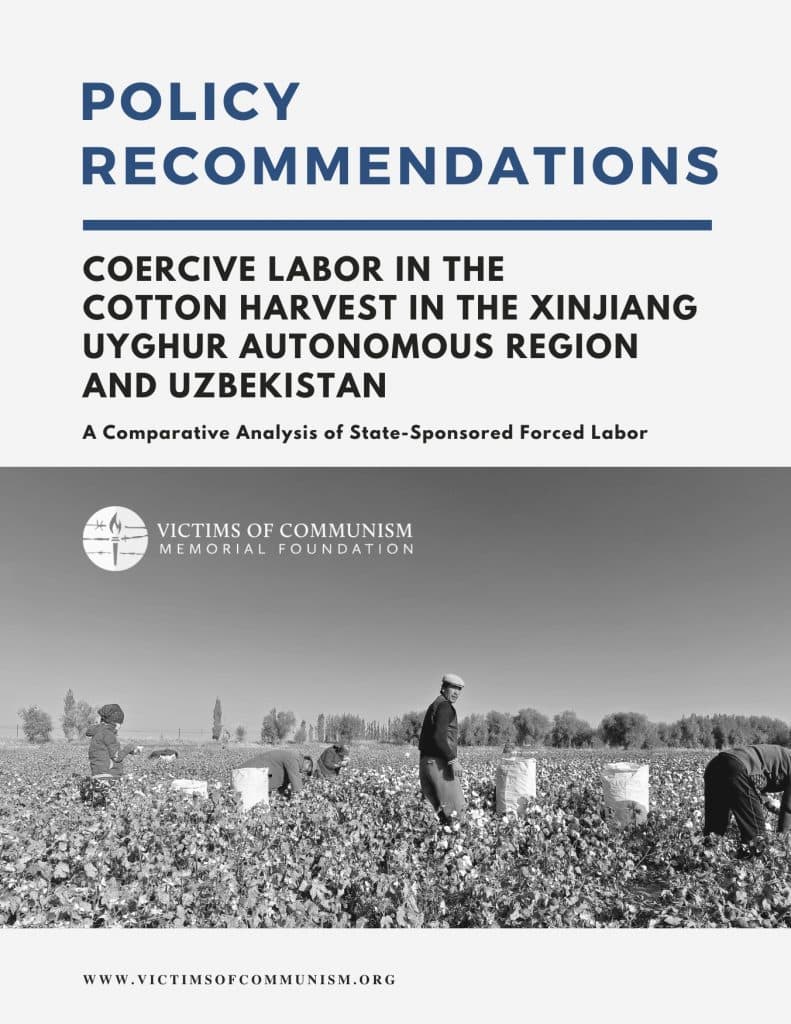
VOC’s policy recommendations based on the findings of the report can be downloaded here. For more context, a detailed discussion on Beijing’s forced labor system in Xinjiang and genocide against the Uyghurs can be found in a recent US House Select Committee on China hearing that featured testimony by VOC’s Dr. Adrian Zenz.